31 December 2014

Best and Worst Books I Read in 2014

Someone asked me on Facebook if I was going to post my favourite books of 2014. I looked back at my list (95 books and 26,442 pages). Here are the best and worst, sorted by category (my categories).

The Best Reads would be rated 5-stars by me on Amazon, which means the book has to **REALLY** have an impact on me. I tried to decide on the 1-3 absolute best and couldn't narrow it down because each is unique and meaningful for different reasons.

The Worst Reads would all be rated 2-stars or less, which means I REALLY did not like them.

If you're interested in seeing my comments on each book, you can view or download this document from my Dropbox account — The Best and Worst Books I Read in 2014

BEST READS OF 2014
  • Unbroken, Laura Hillenbrand (Biography) 
  • A. Lincoln: A Biography, Ronald C White (Biography)
  • Once Blind: The Life of John Newton, Kay Strom Marshall (Biography) 
  • Commentary on Philippians, Colossians, and Thessalonians (only Colossians chapter), John Calvin (Bible) 
  • Expositor's Bible: Colossians and Philemon, Alexander Maclaren (Bible) 
  • The 3D Gospel: Ministry in Guilt, Shame, and Fear Cultures, Jayson Georges (Cross-Cultural Ministry) 
  • Daily Reflections on the Names of God, Ava Pennington (Devotional) 
  • A Hobbit Devotional: Bilbo Baggins and the Bible, Ed Strauss (Devotional) 
  • Revisiting the Master Plan of Evangelism, Robert Coleman and Bobby Harrington (Evangelism) 
  • Faith of My Fathers (Chronicles of the Kings #4), Lynn Austin (Fiction) 
  • The Book Thief, Markus Zusak (Fiction) 
  • To Kill a Mockingbird, Harper Lee (Fiction) 
  • The Secret Life of Pronouns: What Our Words Say About Us, James W. Pennebaker (Language/Psychology) 
  • The Painful Side of Leadership, Jeff Iorg (Leadership) 
  • The Top Ten Mistakes Leaders Make, Hans Finzel (Leadership) 
  • The Meaning of Marriage, Timothy and Kathy Keller (Marriage) 
  • David and Goliath: Underdogs, Misfits, and the Art of Battling Giants, Malcolm Gladwell (Sociology) 
  • The Teeth May Smile but the Heart Remembers, Andrew Rice (Uganda History) 
  • The Monuments Men, Robert M. Edsel (US/Military History)
WORST READS OF 2014
  • Saint Francis of Assisi: A Life Inspired, Wyatt North (Biography)
  • The Legend of Juan Miguel: The Tale of an Unlikely Hero, Anna K. Sargent (Fiction)
  • Pursuit, Jason Garrett (Fiction)
  • Tiaras & Texans, Laina Turner (Fiction)
  • Your Best Nap Now: 7 Steps to Nodding Off at Your Full Potential, Martha Bolton (Humour)
  • How to Solve Soduku (52 Brilliant Ideas), Robin J. Wilson (Non-fiction) 
On the running front, which was the original purpose of this blog ... well, let's just say that was another worst of 2014.  :-(  I'm trying to get back and plan on 2015 being much better.

Run well, y'all,
Bob Allen
Kampala, Uganda

24 December 2014

Book Review: No Greater Valor, by Jerome Corsi

No Greater Valor: The Siege of Bastogne, and the Miracle That Sealed Allied Victory (I read the Kindle edition), by Jerome Corsi, is a (mostly) readable account of the American defense of Bastogne during the Battle of the Bulge. American forces tenaciously held this important crossroads against numerically superior forces and in spite of harsh weather and shortage of both food and ammunition. Because of the weather and the fact that the Bastogne defenders were surrounded by German forces, fresh supplies could not be brought in until the weather broke on 23 December. I'm not competent to declare whether or not this battle is the most courageous ever fought by American troops, but this certainly is a story of courage and determination. The defenders on the ground, the airmen who flew supply drop runs, medics who volunteered to fly into Bastogne in gliders, and Patton and his 3rd Army all demonstrated courage.

I have no military background — missed the Vietnam draft by one graduating class, my draft number was either #162 or #169 (Hey, give me a break — that was 43 years ago). I also don't generally like books about specific battles. Consequently, I struggled a bit with the military organizational vocabulary. Mostly, I just ignored those kinds of details and read for the bigger picture and that was what I found appealing. For me, the book got much better once the preparations to defend Bastogne were done. I did find it appealing to be reading this book on the 70th anniversary of the Battle of the Bulge and the Siege of Bastogne — that was not by design, it's just when I happened to read the book.

Corsi says that his primary purpose in writing this book was "to reexamine the importance of God in our Judeo-Christian historical tradition in a world certain again to be…'nasty, cruel, brutish, and short' once again in the future." I don't believe he accomplished his purpose. Note — that's not the same thing as saying that I don't believe the premise. I just don't think Corsi presented the kind of compelling evidence that he intended. There are certainly examples of faith in action — Patton's distribution of leaflet encouraging the troops to pray, the attendance of both troops and leaders in Mass and Protestant services during lulls in the action, the statements of belief that God had favoured the American. Did God give the generals and other officers extraordinary wisdom in making decisions that seem to be merely fortuitous? I think so. Were the personnel involved motivated and emboldened by a belief that they were fighting to defeat an evil in the Nazis that was built on a Satanic foundation? I think so.

Someone who believes that God does not intervene in human affairs or, certainly, a non-Christian may well find the references to God's help obnoxious. But, if that focus doesn't bother you, this is a really good story of courage and great strategy.

[DISCLAIMER: I received a copy of this book from the publisher as a part of their blogger book review programme, BookLook Bloggers. The expectation by the publisher is that I will write the review that I believe the book deserves. Other than the free copy of the book and continued participation in the reveiw programme, I receive no other compensation from the publisher.]

10 November 2014

Book Review: Same Kind of Different as Me

Denver's voice is the first one heard and he opens the story by saying, "Until Miss Debbie, I'd never spoke to no white woman before. Just answered a few questions, maybe--it wadn't really speakin. And to me, even that was mighty risky since the last time I was fool enough to open my mouth to a white woman, I wound up half-dead and nearly blind." Now, that's a great start to a story -- it caught my attention.

This is a gut-wrenchingly honest book (I even shed a few tears and had a hard time returning to it at one point) -- friendship, loyalty, prejudices, fears, sin, love, forgiveness, doubts, anger, pain, loss, greed, trust, dashed dreams, crushed hopes. Two very dissimilar men (Hall and Denver) become friends -- Hall's wife sort of pushes Hall into the relationship. While it is a book about friendship, the message of the book is equally how much impact one person (Deborah Hall) can have on all the people around her. Interesting way to write the book with the "voices" of Hall and Denver alternating throughout the book -- often every other chapter but, occasionally, there will be 2-3 chapters of Hall followed by a chapter of Denver.

(Disclaimer: The second time through, I received a free review copy from the publisher through their Blogger Review program, BookLook Bloggers. I was free to write the review I believed the book deserved -- an easy task with this book.)

24 August 2014

Book Review: The Way of Kings, Brandon Sanderson

Sanderson created a whole new world for this novel (1st of 10 projected books). It includes various human and human-like beings as well as spren (beings that appear to show various states — fear, pain, glory, wind, anticipation, etc.), crab-like creatures that are used as beasts of burden but also produce valued crystals, and plants that are alive and move in response to stimuli. He also created legends and religion and mythology. Some humans and others are able to take advantage of powers contained within spheres and chips. These powers don't give new abilities, but greatly enhance existing abilities. It took some time to get into the story, primarily because of all the new terminology and cultural references that had to be absorbed.

In the end, the story seems to revolve around 3 primary characters. Kaladin, a surgeon's apprentice turned warrior turned slave turned bridgeman, turned Brightlord protector. Kaladin may be the most complex of the characters and, in some ways the most human of the characters as he struggles with trust and bigotry and figuring out who he really is.

A second primary character is Shallan, a girl from a once powerful family who convinces the king's sister to take her on as a ward, ostensibly to become a scholar but with the intent of stealing Jasnah's Soulcaster, to replace her family's broken soulcaster, and using it to restore her family's fortunes and position.

The third primary character is Dalinar, a Highprince and uncle of King Elhokar. Dalinar is thought to be going crazy because he has lost his passion for war and is intent on uniting the highprinces of Alethkar in order to restore the glory of past kingdoms. In that, he is opposed by all of the other highprinces because they want to retain their individual power and position and ability to gain wealth. He is also resisted by Elhokar because of fear.

These three may not continue to be the primary characters in subsequent books as Wit, Szeth (assassin), and Taravangian seemed to be ascending at the end of the book. Characters well developed and acted reasonably consistently. The worlds are strange. Legends aren't quite clear but Sanderson has a habit of introducing something as if it were clear and then over multiple flashbacks, revealing details. Definitely kept my attention but the length of the series is a bit daunting to even consider.

I read the Kindle edition and really appreciated the X-Ray function for this book!!

Book Review: The Confession, Robert Whitlow

It's always easier for a prosecuting attorney if he has a confession ... or is it? The Confession (link to Kindle edition on Amazon), by Robert Whitlow, is a lawyer story — actually an assistant DA. As a teen, Holt Douglas was drunk but not as much as his friend. He refuses to let his friend drive and takes the keys himself. In the subsequent wreck (didn't see that coming, right?), the friend dies but Holt lives. He makes a decision to tell the police that the friend was driving and lives with the secrecy and guilt of that decision for years afterwards.

As an assistant DA, Holt begins to suspect that the death of a prominent and powerful businessman, Meredith, was not suicide as was reported. Then, with the help of Trish, a detective assigned to locating and bringing to justice men who have defaulted on alimony or family support payments, begins to uncover evidence that Greg, a supporter of the DA and huge contributor to Trish's church, was involved in the death of Meredith and decided that the DA and the Sheriff and some deputies were involved in a massive cover-up. The story involves some conflicted attraction between Holt and Trish that causes trouble between Holt and Angelina, Holt's girlfriend. Whitlow does a good job of weaving in Holt's guilt over hiding the truth about his role in the wreck that killed his friend. Trish's father was killed by a drunk driver, and Whitlow does a good job of weaving in the tension of Trish's anger, especially when Holt tells Trish the truth about his own wreck. The Bishop becomes a key part of the story as Holt moves toward faith. Then, there is a twist or two in the story.

While not great book, The Confession was an engaging read. I rate it 4/5 stars.

(EDIT: I deleted the comment about page numbers not being in the edition I read. In communication with the BookLook Bloggers administration, they said that the review edition does not come from Amazon and may not be formatted the same.)

(DISCLAIMER: I received a free copy of this book from the publisher as a part of their blogger review programme, BookLook Bloggers. I was free to write the review I thought the book deserved and receive no compensation or other benefit except continued participation in the review programme.)

Run well, y'all,
Bob

PS — I've started back running in Kampala. It's known as the city of seven hills and the hills are KILLERS!

18 August 2014

Book Review: Known and Loved: 52 Devotions From the Psalms

Written for Moms by a Mom. I didn't realize that until I started reading — I apparently got it as a free book some time back and found it on my Kindle when I was looking for a devotional guide for the Psalms. I'm glad I didn't realize the "for-moms" part because I would not have read it. There were some really good insights into some of the Psalms. Some chapters less applicable to me since I'm a non-mom. I used it as a daily devotional supplement, reading one per day.

10 August 2014

Traffic in Addis Ababa

This video was supposedly taken at the Ring Road in Addis Ababa. Throughout all the years I've been in East Africa, I've heard that the craziest traffic is, in order of craziest to crazy but less so:
  • Addis Ababa, Ethiopia
  • Kampala, Uganda
  • Nairobi, Kenya
  • Dar es Salaam, Tanzania
Based on this video, they're all about the same!


Run well ... especially if you have to cross traffic like this!
 Bob Allen Kampala, Uganda

26 July 2014

Book Review: The Top Ten Mistakes Leaders Make

(Long review)

Summary: Hans Finzel, past President and CEO of WorldVenture, currently President of HDLeaders. This edition is an update of the original book written in the 1990s. He discusses the problems caused by these top ten mistakes and then talks about how to avoid them. Easily one of the most readable leadership books that I have read. Part of its value is that it’s drawn from Finzel’s experiences in leadership. Highly recommended.
From the Introduction: "Leadership can be dangerous. To understand this, study world history and the lives of great and terrible leaders and what they accomplished through others. We who are in leadership can, on one hand, move men, women, and mountains for tremendous good. On the other hand, we hold the power to do irreparable damage to our followers by the mistakes we make.” (Loc. 98)
Mistakes (chapters):
  • Top–down attitude
  • Putting paperwork before peoplework
  • The absence of affirmation
  • No room for mavericks
  • Dictatorship in decision making (I know all the answers)
  • Dirty delegation
  • Communication chaos — overcommunicate
  • Missing the clues of corporate culture
  • Success without successors
  • Failure to focus on the future
Best Chapter — Chapter 8, Missing the Clues of Corporate Culture, and Chapter 10, Failure to Focus on the Future.
It’s really hard to choose best chapters because they are all good. These 2 chapters, however, speak most directly to my current situation having just moved into a new leadership role. Chapter 8 on corporate culture practically defines culture as “the way we do things around here”. Reading the chapter, I realized that both leaders and followers have to deal with multiple cultures, not just their organization’s culture: birth family, in-law family, regional culture (North, South, Midwest, etc.), organizational culture. International workers add a new country’s culture and, in Africa, tribal cultures. As a new leader of an existing group of teams, I’m having to learn not only new country and tribal cultures but also learn the culture of this group of teams.
Chapter 10 speaks to where I think I need to focus my primary attention in this particular leadership role. Given the realities of changes in my home culture and the financial constraints of our overall organization, I need to look 5-10+ years ahead and lead for those changes.
Best Quotes:
  • ...people fall into leadership more by accident than by design. (Loc. 120)
  • After falling into leadership, we tend to do what comes naturally—we “wing it.” And that’s what gets leaders into trouble, because good leadership practice is often the opposite of conventional wisdom. (Loc. 123)
  • This leader, like most, had no clue as to how much power he wielded over his subordinates. Great leaders forget what it feels like to be led. (Loc. 156)
  • Jesus spent more time touching people and talking to them than doing any other action. His focus was not on words, it was on compassion. (Loc. 699)
  • A person or a number of key people with whom one has had real-life personal contact has been the primary change agent in the person’s life...are influenced by many factors in small ways and at a distance, but the most profound changes in our lives come through people whom we have had coffee with, roomed with, gone to a game with, played with, worshipped with, prayed with. (Loc. 732)
  • The greater the leadership role, the more important peoplework is…. (Loc. 843)
  • Organizational researchers have been telling us for years that affirmation motivates people much more than financial incentives…. (Loc. 865)
  • Leadership is inherently about effecting change in order to obtain some desired future condition that would not otherwise happen. Most people want progress as long as they do not have to change very much to get it. (Loc. 1129)
  • Learn to recognize truly useful mavericks. Some people just love to complain, but there are useful mavericks who do not just cause trouble, but rather truly want to make a difference. We need to create space in our organizations for these beneficial mavericks to flourish. (Loc. 1301)
  • We know by looking at history that the greatest strides forward in any field usually come from the “radical fringe,” as opposed to the institutional core…. (Loc. 1363)
  • The greatest ideas bubble up from the workers. “They will come from you, not from me,”…. (Loc. 1358)
  • “I’m a captain, I don’t gripe to my men. Gripes go up. Not down.” (Tom Hanks character in Saving Private Ryan) (Loc. 1440)
  • No one likes to live under dictators—they take all the fun out of life and work! (Loc. 1607)
  • Being head beagle would be a lot easier if we could learn to spread out the work to other competent workers around us. (Loc. 1656)
  • Our goal is to develop new leaders who will eventually replace us, so we shouldn’t worry about others having skills better than our own. (Loc. 1681)
  • FOUR QUESTIONS EVERY FOLLOWER ASKS: 1. What am I supposed to do? 2. Will you let me do it? 3. Will you help me when I need it? 4. Will you let me know how I’m doing? —Dr. Lorne Sonny, The Business Ministry Journal (Loc. 1744)
  • An important principle that many leaders stumble on is the need to recognize that different kinds of followers need different styles of supervision. (Loc. 1810)
  • “If everything seems under control, you are not going fast enough.” —Mario Andretti (Loc. 1854)
  • I have an imaginary sign over my doorway as you look out of my office that reads, “Did they take their monkey with them?” Don’t do other people’s work for them. That is my natural temptation, like when I ask my children to do a job that I would normally do myself. I must cultivate greater independence and responsibility in both of us by giving them a job and allowing them do it. (Loc. 1858)
  • When left in the dark, people tend to dream up wild rumors. (Loc. 1915)
  • As organizations grow, the original group of founders can become an inside elite. Since they were there from the beginning, they have the most information and power. Newcomers feel left out and in the dark. I recall one of the new employees in our group complaining about the lack of information in this vivid fashion: “I feel like I’m living on a mushroom farm—I’m left completely in the dark and fed manure from time to time.” That was a revealing statement of the kind of pain that can be caused by poor communication. (Loc. 1971)
  • There is never a time when more in-house communication is needed than when a new leader arrives on the scene. People need to know what to expect of their new leader. If you are that person, make sure you overcommunicate as an obsession. (Loc. 2040)
  • Never assume that anyone knows anything. This is a core leadership principle. We can never communicate enough in our organizations. (Loc. 1934)
  • We never communicate enough, and we usually communicate way less than we think we do. It is a rare organization that has been found guilty of over-communicating. (Loc. 2253)
  • When left in the dark, people tend to dream up wild rumors. This is where human nature always shows its dark side. People tend to think the worst of each other, instead of the best. Rumors destroy morale, and are best grown in the fertile soil of a communication-less organization. It is the job of effective leaders to build communication bridges throughout their organization and make sure that people are talking to each other. (Loc. 2261)
  • I define corporate culture very simply as “the way we do things around here.” Or to make the definition a bit more formal: “An organization’s corporate culture is the way insiders behave based on the values and group traditions they hold.” (Loc. 2298)
  • Corporate culture is a powerful force. It can at times be so strong that people develop a religious attitude toward their company, so devoted they are to its culture. (Loc. 2328)
  • One of the keys to a successful leadership transition is to learn to hold our positions loosely. The tighter the grip, the more pride and the harder it becomes to let go at any stage. A loose grip is a humble grip, an attitude that knows our finitude and dispensability. (Loc. 2965)
  • To survive and grow, a movement such as the Christian faith must go at least four generations: Paul (the first generation) mentored Timothy (second), who was in turn was asked to mentor reliable men (third), who would be qualified to teach others (fourth)…. (Loc. 2993)
  • A leader’s concentration must not be on the past nor on the present, but on the future. (Loc. 3092)
  • Leroy Eims, “A leader is one who sees more than others see, who sees farther than others see, and who sees before others do” (Be the Leader You Were Meant to Be). (Loc. 3134)
  • ...our past successes can be our greatest roadblocks to future accomplishments, because what worked in that foreign country of the past will not necessarily work today. (Loc. 3138)
  • The tyranny of the urgent always fights against our planning and thinking time, but if we don’t make the time to plan for the future, we will be its victims. We will develop a style of reactionary leadership. What is needed is proactive leadership that anticipates the future. (Loc. 3219)
  • Leaders ask, “Where are we going next, and why are we going there?” Managers ask, “How will we get there?” (Loc. 3233)
  • ...the world outside is changing; the international community we want to touch is changing; our new workforce is different, with different expectations; and our donor base is changing dramatically…. (Loc. 3281)
  • Creating vision and direction for the future is one of the primary responsibilities of leadership. The leader must plan for the future. He or she must direct or head the team in developing organizational goals, plans, and strategies that flow out of a crisp purpose or vision statement. (Loc. 3298)
  • “In times of change, learners inherit the earth, while the learned find themselves beautifully equipped, to deal with a world that no longer exists.” —Robin Cook, Abduction (Loc. 3311)
  • The past is finished. Whatever happened there cannot be undone. The present is being dealt with on the basis of yesterday’s plans. That leaves only the future as the focus of an effective leader. To neglect the future is the biggest mistake a leader can make. (Loc. 3394)
Best Take-Aways:
  • ...“communication linkages.” Every time I make a phone call or write a letter or make a decision, I have to ask, “What people are affected by this decision/letter/memo/directive? What are the linkages?” (Loc. 2011)
  • Learn the culture of where I am (Chapter 8)
  • Focus on the future: “…the past is finished…the present is being dealt with on the basis of yesterday’s plans…That leaves only the future….” (Loc. 3394)

20 July 2014

Book Review: A Deadly Business


This was an enjoyable read. I was a little put off to find that it is the second book in a series (I hadn't read the first), but it really stands alone. Not a bad book — a bit of courtroom drama, an accidental death that might be a murder, a dead husband who turns out not to have been what he seemed, a bit of romance between Mia and Charlie (but not over the top or graphic in any way, even by implication). There were some odd things in the book that seemed out of place: for instance, Eli blurting out that Mia is his girlfriend — where did that come from? The side story about the lady and her son who were living in a friend's garage and then moved into Mia's spare bedroom seemed an odd, out-of-place, and totally unnecessary insertion in the story and the conflict over that with Gabe was never resolved. Gabe's character as a 14 year old was well developed and seemed true to life. I'm not sure what qualifies this as "Christian fiction". And I'm not sure what characterizes "Christian fiction -- is it overt Christianity (not in this book), is it morality (the language was clean and there was no gratuitous sex or adultery in the book), is it a Biblical worldview (that existed in the book but was very subtle and seemed motivated by a desire on the part of the characters to be good, not necessarily biblical)?

If you're looking for a light mystery that's an easy read with enough unknowns to maintain interest, then you will probably enjoy "A Deadly Business".

(I received a free copy of A Deadly Business for review from the publisher as a part of their blogger review program, Book Look Bloggers.  I was free to write the review that I thought the book deserved. I receive no compensation other than continued participation in the program.)

01 July 2014

Book Review: The Case for a Creator, Student Edition

One of my biggest disappointments as an adult has been to realize the deficiencies of my high school science courses. So, I approach books like The Case for a Creator: Student Edition very much as a layman.

The Case for Faith was the first of Lee Strobel's books that I read. It was a refreshingly clear apologetic not only in the rationality of belief in God but also for placing one's trust in God alone. Later, I read "The Case for Christ" and found it to be just as clear.

I expected the same kind of approach in The Case for a Creator and I was right. Strobel's raises the questions about creation and then consults with experts who are Christians to find the answers. The material is presented in a way that even a science layperson can follow and (mostly) understand. He presents the arguments for creation versus evolution clearly. This book should help Christian students know how better to articulate why creationism is a reasonable worldview. Strobel lays out some of the weaknesses of a belief in evolution.

After reading The Case for a Creator, I did have some concerns. First, while I haven't read the original edition, this student edition read like portions of the longer edition were simply cut and pasted to make an abridged version. Second, much to my surprise, I found that Strobel's signature method was actually a little tiring after having read two others of his books. Finally, I wonder if Strobel has addressed the most recent issues in evolutionary science or if he has consulted the most competent scholars — I don't know that he hasn't but others who have reviewed this book have indicated that he hasn't.

Apart from the content and style of the book, I found some significant issues with the Kindle edition:  sidebars are inserted into the main text in ways that are somewhat confusing and in at least one case, a sidebar is inserted in the middle of a sentence. Also, some typical navigation features are missing — direct access to individual chapters via the "Go To" menu and the "swipe up" navigation feature of the Paperwhite. My copy is a review edition provided by the publisher for the purpose of review. I've asked the publisher about these issues. They've said the review copy should be the same as the purchase copy but that they would investigate my concerns and let me know. After almost 2 weeks, I have heard nothing further. These formatting issues are not unique to this book nor are they unique to Kindle books published by Harper-Collins. They don't take away from the value of the book — they simply make it a little more difficult to read.

I do recommend this book as a basic text for students. It is helpful in developing a creation apologetic. However, I don't think it should be the only book that someone should read on intelligent design or on creationism.

(NOTE: I received a free copy of The Case for a Creator: Student Edition from the publisher in exchange for writing a review of the book as a part of their BookLook blogger review program. I have been free to write the review that I think the book deserves and receive no other compensation except continued participation in the review program.)

04 April 2014

Book Review: Critical Condition

I'm a fan of Richard Mabry's books. Critical Condition is the fifth one I've read — somehow I missed Heart Failure, but I'll rectify that — and it was not a disappointment. The book will be released on 15 April 2014.

Shannon Frasier, first year medical student, witnesses the shooting death of her fiancé, Todd, and is helpless to help him. Ten years later, as a surgeon in a Dallas hospital, another man is shot and killed in her front yard and she is, again, powerless to help him.

Shannon, her recovering addict sister, Megan, and her almost-fiancé, Mark, get tangled in a bank robbery/murder case. In the midst of all of this, Shanon struggles with her weakened faith in God.

As always, Mabry's medical/murder mystery compelled me to finish. His characters are real, struggling with daily issues of stress, faith, fallenness, doubt. I like and appreciate the fact that Mabry's does not resort to foul language or to sex scenes to "enhance" (tongue-in-cheek) his stories. Even though two of the main characters are doctors, the storyline itself is only tangentially related to the medical profession.

While this was a really good read, there are weaknesses in the plot. Shannon, Mark, and Megan's interferences in the investigation would probably have earned them serious trouble in real life. I sincerely hope that the Dallas police would have taken the threats against Shannon's life more seriously than the story portrays. Some things that seemed weak in the first half of the book made sense later (I won't detail to avoid spoilers).

Shannon's struggles with her own doubts about God may seem trite to non-believers, its a very real struggle for many believers -- how to reconcile one's belief in a loving God with difficulties and evil in daily life. Once again, I highly recommend Mabry's books.

(DISCLAIMER: I received a copy of Critical Condition free from the publisher as a participant in their Book Look Bloggers program. However, I was free to write the review that I believed the book deserved. My only compensation is continued participation in the review program.)

27 March 2014

Book Review: Take This Cup (edited 28 March 2014)

I was first introduced to Bodie Thoene's writing with her Zion Covenant and Zion Chronicles series (currently, on Amazon, both Bodie and Brock are listed as authors for these series of books; the editions I read in 1991 were attributed only to Bodie). I was enthralled with her portrayal of the Jewish experience in Germany. Then, I read The Man From Shadow Ridge, written by Bodie and Brock Thoene, and was greatly disappointed. The writing was lifeless and the story seemed forced. So, I was pleasantly surprised that I enjoyed Take This Cup. I was concerned when I found that this is book #2 in a series. However, it seems to stand well on its own.

This book needs to be read as fiction -- it doesn't purport to be anything else. A young boy, Nehemiah, born to a shepherd and a crippled weaver, is "chosen" as the cup-bearer, to bear the cup of blessing and suffering that has passed from Melchizidek to Abraham, to Joseph (the cup placed in Benjamin's bag), and now is to go to the Messiah. Nehemiah's rabbi was one of the wise men who visited Jesus after his birth. Nehemiah must endure a long, perilous journey to get to Jerusalem in time to pass the cup to the Messiah. There are some odd inclusions:
* The white hart that supposedly survived from Eden is almost a spirit-guide. This is inconsistent with the book's basis in the biblical message about the Messiah.
* The star patterns predicting the Messiah's return seems out of character for the story.
* Bible passages seem to be used in contexts in which they were not initially used.

One thing that the Thoenes do stress in the story is that the Jewish people were expecting the Messiah to be a military/political leader who would overthrow the Romans and reestablish the Jewish nation under a descendent of David. In that interpretation, the crowd celebrating Jesus' entry into Jerusalem and then turning against him a few days later makes sense. Jesus, a descendent of David, was not the kind of Messiah they expected, so they turned on him.

Take This Cup is an engaging, fun read as long as it's treated as very fictionalized.

(DISCLAIMER: I received a free copy of this book from the publisher's Book Look Bloggers program in exchange for writing a review. I was free to write the review that I thought the book deserved.)

18 January 2014

Book Review: The Prodigal: A Ragamuffin Story

Mega-church pastor, Jack, falls from grace — not in the sense of losing his salvation, but he gets drunk and sleeps with his assistant when they get stranded on a church missions publicity trip. The church he founded fires him, his wife leaves and takes their daughter. Jack is devastated by what "they" are doing to him and refuses to acknowledge doing anything wrong. He retreats to a getaway where, over a 2-month period, he tries to drink away his problem. But he's rescued by his father from whom he has been estranged for 10 years.

Back "home", Jack begins the long process of facing who he really is, what God really thinks about him, and restarting his life. It's a good story that hits close to home in that we all have failed, in some way, to live up to our own expectations of our self and we struggle with how to be worthy enough to be accepted by God and others.

Some of the characters were particularly well developed — Tom, Jack's father; Frank, the Catholic priest who advocates for grace; and James Taylor, the despicable mayor.

While I recognize that I come from a different religious tradition than Manning and the characters in his book, I found the liberal use of alcohol by believers unsettling. It was not just by one or two characters, but by many (maybe most). And, with the 3 main characters, there was misuse, even abuse, of alcohol that essentially went unchallenged, even as it led to problems.

The basic message of the book — that God loves us, extends his grace to us when we don't deserve it, and is forgiving — is a great theme and one that's necessary. The problem, in my limited exposure to the US over the last many years, is that this is a theme that is taken to the extreme by some (Osteen, for example) to the point where there is no repentance necessary. Thus, Jack's focus as a mega-church pastor — we've all totally ruined our live — seems like a straw man. However, his focus on self-improvement (we have to do better) seems to be a more common thread — works-based salvation. The truth is between those two — we have sinned, we do need a Saviour, God does extend his grace and we can repent and turn to him for forgiveness and eternal life. Jack finally experiences God's grace and forgiveness as he slowly realizes that the love he receives from his earthly father is a picture of how God deals with us.

I rate the book 4 of 5 stars. If you're struggling with guilt because of real sin, this is a great book to read to help you see God's love and forgiveness at work. It's also an enjoyable story of one man's struggle.

(DISCLAIMER: I received a free copy of this e-book in exchange for a review of the book through Thomas Nelson's blogger review program, Booksneeze. I have been free to write the review I think the book deserves.)

07 January 2014

Book Review: "The Total Money Makeover"

Read this book and put the principles into practice. You have to do both. If you're only going to read it, don't spend the money on the book in the first place.

I had just talked to one of my brothers and sisters-in-law about Dave Ramsey's financial advice and books when I checked on available books via Thomas Nelson's blogger review programme, Booksneeze. Ramsey's book, The Total Money Makeover, was available, so I decided to see what I thought. My brother and sister-in-law are big fans. She says Ramsey's advice helped her see the error of her own financial management. And, while I don't think of them as wealthy, they are financially comfortable.

Let me acknowledge that this book was not really written for me (just shy of 60 years old). It barely addresses financial issues that I face as I don't have 20 years before retirement. We do use credit cards but have no debt, have an adequate nest egg, and our kids are already through with university.

First impressions: a lot of hype and a lot of cliches and sound bites. I've never listened to Ramsey's radio programme but I often felt like I was reading a transcript, particularly in the first part of the book, which seemed primarily motivational. That is fine, but I didn't really need that.

All of that being said, this is an excellent read for anyone who has consumer debt or who is undisciplined with finances or who has 20 years or more before retirement. Ramsey lays out clear principles and plans for controlling one's finances rather than letting them control you. And, it doesn't matter whether one has an annual income of $25,000 or $225,000 — the principles and the plans apply. In fact, this book may be more important for the one with the $25,000 income.

Ramsey's primary messages, though he doesn't use these phrases, "get out and stay out of debt — avoid it like a plague" and "be laser-focused on working your financial plan" (Ramsey's phrase is "focused intensity"). His advice is sound, though it may be unconventional:
  • Quickly set aside a starter emergency fund
  • Get rid of consumer debt, starting with the smallest debt first — early success is a strong motivator for future effort.
  • Complete your emergency fund
  • Maximize retirement savings
  • Save for your kids' college
  • Pay off your mortgage
  • Build wealth
  • Give, have fun, invest
His motto is, "If you will live like no one else, later you can live like no one else."

For me, the biggest weaknesses of the book are:
  • It's cliche-ridden — to be fair, though, he warns the reader up front that it will be.
  • I think he doesn't make a strong enough emphasis on giving early in the book. One could get the impression that giving doesn't begin until one has built wealth.
  • He doesn't address what to do if one is within 10 years of retirement and doesn't have decades to build wealth.
But, none of those weaknesses detract from the importance or helpfulness of The Total Money Makeover.

Run well, y'all,
Bob

[DISCLAIMER: I received a free copy of this book from the publisher in exchange for an honest review of the book. My future participation in the program is not dependent on how I review the book, I'm free to write the review that I think the book deserves.]

09 December 2013

Perceived Corruption — A Threat to Develpment

I am not an economist — I took precisely one course in economics in university and that was an entry–level course that I took primarily to get the hours I needed for graduation. (Hindsight: I wish, now, I had taken the course more seriously.) But, it doesn't take an economics genius to see that when an investor (either national or expatriate) is considering whether or not to spend money and energy in developing a business in a particular place, a country that is perceived to be corrupt is not going to be high on that investor's list of places to go.

Transparency International has released its 2013 report on Corruption Perception Index. I think it's very important to note that this report doesn't attempt to measure actual corruption — merely the perception of corruption in the public sector (bribes, backroom deals). And, in this case, it may well be true that perception is reality. For more details, go to TI's site. For a quick look at a particular country, put your cursor over that country. Scores range from 8 to 91, with 8 being the countries (Somalia, North Korea, and Afghanistan) perceived as being the most corrupt. Rankings are 1-177, with those same 3 countries tied for worst with a ranking of 175.


Having lived in Kenya for most of the past 27 years and now looking forward to moving to Uganda, it is very sad to me that the corruption in both of those countries has such a huge negative impact on the citizens of those countries.

Run well, y'all,
Bob

16 November 2013

Book Review: "Unleader" by Jane Overstreet

Unleader: The Surprising Qualities of a Valuable LeaderUnleader: The Surprising Qualities of a Valuable Leader by Jane Overstreet

My rating: 5 of 5 stars


Overstreet compares and contrasts the lives of Saul and David to illustrate the character and qualities of a Godly leader. Best chapter is 4 "Do I Use Up or Build up People Under My Leadership" b/c she talks about a righteous leader helping people to move beyond their potential. (David and the rabble who became "mighty men".) Take-aways: be more interested in the wellfare of followers than of your own; own mistakes and immediately repent of sin; find security in God's love, not in approval or winning; the end does not justify the means.

The book is not without small problems. She was slow in pointing out that Saul referred to God as "the Lord **your** God" (emphasis mine) and then only mentioned 1 of 3 instances. She also didn't point out that Saul was sorry that he disappointed Samuel and not, apparently, that he had sinned against God. But, these are also matters of interpretation and don't take away from the value of the book.


View all my reviews

Book Review: "Christ-Centered Preaching & Teaching"

Short book (36 pages) but good, quick overview of the topic.

Christ-Centered Preaching TeachingChrist-Centered Preaching Teaching by Ed Stetzer

My rating: 4 of 5 stars


Compilation of blog posts from Stetzer's blog on Christianity Today. For me, this was a somewhat unfamiliar topic and I felt like they were splitting hairs, straining at gnats in distinguishing between ways to approach Christ-centered preaching. For one not familiar with technical theological vocabulary (soteriology, eschatology, etc.), have a dictionary available. The consensus seems to be that the best preaching and teaching is to take the tack that all of Scripture shows God's plan of redemption that was completed in Christ. Good about pointing out the pitfalls of this approach. The examples of how to treat Samson and Delilah and David and Goliath were very helpful for me and the best part of this short book.


View all my reviews

10 November 2013

Book Review: "Dead Lawyers Tell No Tales"

(I read the Kindle edition.) Really good book. Landon, a former SEC quarterback who was convicted of point shaving, gets out of jail, immediately marries girlfriend & mother of child. In prison, finds faith in God and finishes law school. Finally gets hired by lawyer, Harry, about whom he initially questions his ethics but develops a high respect for his investigative and trial gut sense and, though he doesn't always agree with Harry, realizes that he is ethical.

Kerri, Landon's wife, is a budding investigative journalist who gets some unusual breaks. Both Landon and Kerri are suddenly immersed in intrigues -- murder trial for which Landon is the assistant lawyer to Harry, client is accused of insider trading, Kerri is being "sponsored" by the head of a clandestine security agency and is offered an easy path to a dream reporting job. Things begin to fall apart when 3 lawyers with Landon's firm are killed and Landon takes the lead in the murder case.

There are a number of twists and turns in the book that compelled me to continue reading to find out what would happen. Singer weaves the plot skillfully so that the end is never clear. Both Landon and Kerri struggle with attraction to someone else but are held in check by their love for each other and their strong faith, though Landon's friendship with Rachel crosses an emotional line.

The story deals with friendship, true loyalty, temptations and testing, and faith in ways that I did not find obnoxious. (DISCLAIMER: I share the principles of the main characters. Some will find the Epilogue too evangelistic, but it's consistent with both the faith of the characters and with Singer's 'day job'.) There's even a twist at the end that's reminiscent of O. Henry stories and Jeffrey Archer books and short stories.

To me, the biggest problem with the book is that it seems very unreal to have a rookie, first-year lawyer develop instincts and insights so quickly -- taking on a 1st amendment case, talking seriously about opening his own law firm in DC, etc. Frankly, that's the only reason for 4-stars instead of 5-stars -- Landon and Kerri are just a bit too good at what they do. I thought the book was as good as Grisham and the language was less offensive, as in no foul language. HIGHLY RECOMMENDED.

09 November 2013

Book Review: "An Exposition of the Epistle of St. Paul to the Colossians, Vol. 1"

John Davenant (London, 20 May 1572 – Salisbury, 20 April 1641) was an English academic and bishop of Salisbury from 1621. He also served as one of the British delegates to the Synod of Dort. (Wikipedia article)

Davenant seems to have advocated a middle-ground position between Arminianism and strict Calvinism termed by one observer as "hypothetical universalism, a general atonement in the sense of intention as well as sufficiency, a common blessing of the cross, and a conditional salvation. All these views stood in close connection with the theology of the well-meant offer of salvation to all." (Hanko, Prof. Herman C., "The History of the Free Offer", Chapter 5)

Davenant's "Expositio Epistola D. Pauli ad Colossenses, had been delivered in a series of Lectures to the Students at Cambridge, as Lady Margaret's Professor. This, as it is his most valuable work, so was it the first he issued. It was published at Cambridge in 1627, republished in 1630, and went into a third edition in 1639; each edition being in small folio. There is also a quarto edition, printed at Amsterdam in 1646. The character of this book has been happily expressed by a popular writer in the following terms: "For perspicuity of style and accuracy of method; for judgment in discerning and fidelity in representing the Apostle's meaning; for strength of argument in refuting errors, and felicity of invention in deducing practical doctrines, tending both to the establishment of faith, and the cultivation of holiness, it is inferior to no writing of the kind; and richly deserves to be read, to be studied, to be imitated, by our young divines."* We may also subjoin the testimony of an invaluable living writer, who in a letter to the translator, observes, " I know no exposition upon a detached portion of Scripture (with, perhaps, the single exception of Owen on the Hebrews) that will compare with it in all points. Leighton is superior in sweetness, but far inferior in depth, accuracy, and discursiveness."" (John Davenant (2013-01-01). 1 - An Exposition of the Epistle of St. Paul to the Colossians (Kindle Locations 567-576). Hamilton, Adams and co.. Kindle Edition)

Though at times, both because of 19th century English writing and because of the formatting, this book was quite tedious to read, there are some real gems of insight in Davenant's exposition of Colossians 1-2. I especially liked his explanation on Col 2:14-15.

I used the Google Books edition and then used Amazon's app, Send to Kindle, to convert Google's PDF to Kindle format. That resulted in OCR transcription errors and tended to insert footnotes in odd places in the book. A few times it was best to go to the PDF scan in order to find where the actual text left off and continued.

As would be expected in the early 1600s, there is a fair amount of anti-Catholicism in Davenant's writing. He contrast what he sees as an accurate interpretation of Colossians with the Catholic Church's doctrine.

Davenant does an excellent job of explaining Paul's view on the sufficiency of Christ for salvation and the errors of depending on traditions, works, and human effort to gain God's favour.

If you're willing to wade through the difficulties, this is a good book. Purchasing a printed copy of the book from Amazon would probably make for an easier read. Or, reading the PDF scan on a device and app that faithfully reproduces the scan would also be easier (the Kindle eReader does a poor job of reproducing pure PDFs).

08 November 2013

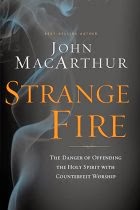
Book Review: Strange Fire, by John MacArthur

Strange Fire (release date, 12 November 2013) is an important book for Christians who long to be faithful to biblical teaching. It will be controversial as Dr. MacArthur takes a very confrontational stance on the charismatic movement. MacArthur is a strident cessationist, believing that the spiritual gifts commonly referred to as "sign gifts" (healing, miracles, prophecy, tongues, and interpretation of tongues) and the office of Apostle ceased to exist at the end of the Apostolic Age (roughly the end of the first century AD). He also issues a stern warning about the so-called "Prosperity Gospel" — the belief that those who are truly saved and who have enough faith will experience financial prosperity and physical health He calls out prominent charismatics and accuses them of fraudulent teaching about and use of these spiritual gifts and their teaching on "blessings" (the prosperity gospel), going so far as to say that they are completely unbiblical and are from Satan rather than God's Spirit. A few times, he references a Pew study that concluded that in some countries, 90% of all Pentecostals believe the same as these prominent figures.

MacArthur paints with a very broad brush, splattering paint everywhere. He challenges the teaching of several non-pentecostal evangelicals and calls them to move to a cessationist position on these spiritual gifts — John Piper, Henry Blackaby, and others.

In spite of the fact that I think MacArthur is too broad in his condemnations, this is a good book. It is written in 3 parts, each part having 4 chapters:

Part 1: Confronting a Counterfeit Revival
Ch 1 Mocking the Spirit
Ch 2 A New Work of the Spirit?
Ch 3 Testing the Spirits (Part 1)
Ch 4 Testing the Spirits (Part 2)
Part 2: Exposing the Counterfeit Gifts
Ch 5 Apostles Among Us?
Ch 6 The Folly of Fallible Prophets
Ch 7 Twisting Tongues
Ch 8 Fake Healings and False Hopes
Part 3: Rediscovering the Spirit's True Work
Ch 9 The Holy Spirit and Salvation
Ch 10 The Spirit and Sanctification
Ch 11 The Spirit and the Scriptures
Ch 12 An Open Letter to My Continuationist Friends

He concludes the book with an Appendix tracing cessationist thought from the 4th century forward.

Best Chapters: In Chapters 3 and 4, MacArthur uses 1 John 4:1-8 to give a biblical method of testing the validity of any claim to the working of God's Spirit. This is excellent exegesis which builds on an exposition of Jonathan Edwards as he evaluated the Great Awakening of the 18th century. The appropriate questions to ask are:
1. Does the work exalt the true Christ?
2. Does it oppose worldliness?
3. Does it point people to the Scriptures?
4. Does it elevate the truth?
5. Does it produce love for God and others?

Any supposed movement of the Holy Spirit that does not do all of those, is not a movement of God's Spirit and is, therefore, false.

Key Quotes:

Introduction: The “Holy Spirit” found in the vast majority of charismatic teaching and practice bears no resemblance to the true Spirit of God as revealed in Scripture. The real Holy Spirit is not an electrifying current of ecstatic energy, a mind-numbing babbler of irrational speech, or a cosmic genie who indiscriminately grants self-centered wishes for health and wealth. The true Spirit of God does not cause His people to bark like dogs or laugh like hyenas; He does not knock them backward to the ground in an unconscious stupor; He does not incite them to worship in chaotic and uncontrollable ways; and He certainly does not accomplish His kingdom work through false prophets, fake healers, and fraudulent televangelists. By inventing a Holy Spirit of idolatrous imaginations, the modern Charismatic Movement offers strange fire that has done incalculable harm to the body of Christ. Claiming to focus on the third member of the Trinity, it has in fact profaned His name and denigrated His true work.

Charismatic theology has turned the evangelical church into a cesspool of error and a breeding ground for false teachers. It has warped genuine worship through unbridled emotionalism, polluted prayer with private gibberish, contaminated true spirituality with unbiblical mysticism, and corrupted faith by turning it into a creative force for speaking worldly desires into existence. By elevating the authority of experience over the authority of Scripture, the Charismatic Movement has destroyed the church’s immune system–uncritically granting free access to every imaginable form of heretical teaching and practice.

Chapter 1: Some might argue, however, that such heretical elements represent only the lunatic fringe of an otherwise orthodox movement. More moderate charismatics like to portray the prosperity preachers, faith healers, and televangelists as safely isolated on the extreme edge of the charismatic camp. Unfortunately, that is not the case. Thanks to the global reach and incessant proselytizing of religious television and charismatic mass media, the extreme has now become mainstream. For most of the watching world, flamboyant false teachers–with heresies as ridiculous as their hairdos–constitute the public face of Christianity.

Chapter 2: Edwards argued with his usually lucid logic that intense physical phenomena such as “tears, trembling, groans, loud outcries, agonies of body or the failing of bodily strength” did not prove anything one way or the other about the legitimacy of a revival.

Chapter 4: A comparison of Ephesians 5:18 with Colossians 3:16 demonstrates that the command to “be filled with the Spirit” is parallel to the command to “let the word of Christ dwell in you richly,” since they both produce the same results (cf. Eph. 5:18–6:9; Col. 3:16–4:1)...It is not possible for God’s Word to dwell in believers unless they are filled with the Spirit; and conversely, Christians can’t be filled with the Spirit without the Word of Christ dwelling

Chapter 6: ...if someone declaring himself a prophet proclaims any supposed “revelation from God” that turns out to be inaccurate or untrue, he must be summarily rejected as a spokesman for God.

Chapter 10: being “slain in the Spirit” is a modern charismatic invention. The practice is mentioned nowhere in the Bible; it is completely without scriptural warrant. The modern phenomenon has become such a common and popular spectacle that the average charismatic today takes it for granted, assuming it must have some kind of clear biblical or historical pedigree. But not only is this phenomenon completely absent from the biblical record of the early church; it has nothing whatsoever to do with the Holy Spirit.

...for those who wonder if they are truly being filled with the Holy Spirit, the proper question is not, “Have I had an ecstatic experience?” Rather, it is, “Am I becoming more and more like Jesus?”

Chapter 11: ...the Reformation was the inevitable and explosive consequence of the Word of God crashing like a massive tidal wave against the thin barricades of man-made tradition and hypocritical religion.

Recommendation: MacArthur's defense of cessationism is compelling and has caused me to rethink my own position as a non-charismatic continuationist — though I'm probably more accurately labeled a functional cessationist.

There is much truth in this book in spite of the confrontational tone. It is worth reading by both charismatics and non-charismatics. MacArthur's exposition of Scripture should be taken seriously.

UPDATE: John Piper has responded to inquiries about MacArthur's comments related to his views as a continuationist. Frankly, I think both oversimplified the issues, particularly of prophecy, but this is a good counter to MacArthur's comments about Piper: Piper Addresses Strange Fire and Charismatic Chaos.

(DISCLAIMER: I received this book, Kindle edition, free for pre-publication review from the publisher's Booksneeze blogger's review program. I received no other compensation except for continued participation in the program and have been free to write the review that I think the book deserves.)