20 July 2014

Book Review: A Deadly Business


This was an enjoyable read. I was a little put off to find that it is the second book in a series (I hadn't read the first), but it really stands alone. Not a bad book — a bit of courtroom drama, an accidental death that might be a murder, a dead husband who turns out not to have been what he seemed, a bit of romance between Mia and Charlie (but not over the top or graphic in any way, even by implication). There were some odd things in the book that seemed out of place: for instance, Eli blurting out that Mia is his girlfriend — where did that come from? The side story about the lady and her son who were living in a friend's garage and then moved into Mia's spare bedroom seemed an odd, out-of-place, and totally unnecessary insertion in the story and the conflict over that with Gabe was never resolved. Gabe's character as a 14 year old was well developed and seemed true to life. I'm not sure what qualifies this as "Christian fiction". And I'm not sure what characterizes "Christian fiction -- is it overt Christianity (not in this book), is it morality (the language was clean and there was no gratuitous sex or adultery in the book), is it a Biblical worldview (that existed in the book but was very subtle and seemed motivated by a desire on the part of the characters to be good, not necessarily biblical)?

If you're looking for a light mystery that's an easy read with enough unknowns to maintain interest, then you will probably enjoy "A Deadly Business".

(I received a free copy of A Deadly Business for review from the publisher as a part of their blogger review program, Book Look Bloggers.  I was free to write the review that I thought the book deserved. I receive no compensation other than continued participation in the program.)

01 July 2014

Book Review: The Case for a Creator, Student Edition

One of my biggest disappointments as an adult has been to realize the deficiencies of my high school science courses. So, I approach books like The Case for a Creator: Student Edition very much as a layman.

The Case for Faith was the first of Lee Strobel's books that I read. It was a refreshingly clear apologetic not only in the rationality of belief in God but also for placing one's trust in God alone. Later, I read "The Case for Christ" and found it to be just as clear.

I expected the same kind of approach in The Case for a Creator and I was right. Strobel's raises the questions about creation and then consults with experts who are Christians to find the answers. The material is presented in a way that even a science layperson can follow and (mostly) understand. He presents the arguments for creation versus evolution clearly. This book should help Christian students know how better to articulate why creationism is a reasonable worldview. Strobel lays out some of the weaknesses of a belief in evolution.

After reading The Case for a Creator, I did have some concerns. First, while I haven't read the original edition, this student edition read like portions of the longer edition were simply cut and pasted to make an abridged version. Second, much to my surprise, I found that Strobel's signature method was actually a little tiring after having read two others of his books. Finally, I wonder if Strobel has addressed the most recent issues in evolutionary science or if he has consulted the most competent scholars — I don't know that he hasn't but others who have reviewed this book have indicated that he hasn't.

Apart from the content and style of the book, I found some significant issues with the Kindle edition:  sidebars are inserted into the main text in ways that are somewhat confusing and in at least one case, a sidebar is inserted in the middle of a sentence. Also, some typical navigation features are missing — direct access to individual chapters via the "Go To" menu and the "swipe up" navigation feature of the Paperwhite. My copy is a review edition provided by the publisher for the purpose of review. I've asked the publisher about these issues. They've said the review copy should be the same as the purchase copy but that they would investigate my concerns and let me know. After almost 2 weeks, I have heard nothing further. These formatting issues are not unique to this book nor are they unique to Kindle books published by Harper-Collins. They don't take away from the value of the book — they simply make it a little more difficult to read.

I do recommend this book as a basic text for students. It is helpful in developing a creation apologetic. However, I don't think it should be the only book that someone should read on intelligent design or on creationism.

(NOTE: I received a free copy of The Case for a Creator: Student Edition from the publisher in exchange for writing a review of the book as a part of their BookLook blogger review program. I have been free to write the review that I think the book deserves and receive no other compensation except continued participation in the review program.)

04 April 2014

Book Review: Critical Condition

I'm a fan of Richard Mabry's books. Critical Condition is the fifth one I've read — somehow I missed Heart Failure, but I'll rectify that — and it was not a disappointment. The book will be released on 15 April 2014.

Shannon Frasier, first year medical student, witnesses the shooting death of her fiancé, Todd, and is helpless to help him. Ten years later, as a surgeon in a Dallas hospital, another man is shot and killed in her front yard and she is, again, powerless to help him.

Shannon, her recovering addict sister, Megan, and her almost-fiancé, Mark, get tangled in a bank robbery/murder case. In the midst of all of this, Shanon struggles with her weakened faith in God.

As always, Mabry's medical/murder mystery compelled me to finish. His characters are real, struggling with daily issues of stress, faith, fallenness, doubt. I like and appreciate the fact that Mabry's does not resort to foul language or to sex scenes to "enhance" (tongue-in-cheek) his stories. Even though two of the main characters are doctors, the storyline itself is only tangentially related to the medical profession.

While this was a really good read, there are weaknesses in the plot. Shannon, Mark, and Megan's interferences in the investigation would probably have earned them serious trouble in real life. I sincerely hope that the Dallas police would have taken the threats against Shannon's life more seriously than the story portrays. Some things that seemed weak in the first half of the book made sense later (I won't detail to avoid spoilers).

Shannon's struggles with her own doubts about God may seem trite to non-believers, its a very real struggle for many believers -- how to reconcile one's belief in a loving God with difficulties and evil in daily life. Once again, I highly recommend Mabry's books.

(DISCLAIMER: I received a copy of Critical Condition free from the publisher as a participant in their Book Look Bloggers program. However, I was free to write the review that I believed the book deserved. My only compensation is continued participation in the review program.)

27 March 2014

Book Review: Take This Cup (edited 28 March 2014)

I was first introduced to Bodie Thoene's writing with her Zion Covenant and Zion Chronicles series (currently, on Amazon, both Bodie and Brock are listed as authors for these series of books; the editions I read in 1991 were attributed only to Bodie). I was enthralled with her portrayal of the Jewish experience in Germany. Then, I read The Man From Shadow Ridge, written by Bodie and Brock Thoene, and was greatly disappointed. The writing was lifeless and the story seemed forced. So, I was pleasantly surprised that I enjoyed Take This Cup. I was concerned when I found that this is book #2 in a series. However, it seems to stand well on its own.

This book needs to be read as fiction -- it doesn't purport to be anything else. A young boy, Nehemiah, born to a shepherd and a crippled weaver, is "chosen" as the cup-bearer, to bear the cup of blessing and suffering that has passed from Melchizidek to Abraham, to Joseph (the cup placed in Benjamin's bag), and now is to go to the Messiah. Nehemiah's rabbi was one of the wise men who visited Jesus after his birth. Nehemiah must endure a long, perilous journey to get to Jerusalem in time to pass the cup to the Messiah. There are some odd inclusions:
* The white hart that supposedly survived from Eden is almost a spirit-guide. This is inconsistent with the book's basis in the biblical message about the Messiah.
* The star patterns predicting the Messiah's return seems out of character for the story.
* Bible passages seem to be used in contexts in which they were not initially used.

One thing that the Thoenes do stress in the story is that the Jewish people were expecting the Messiah to be a military/political leader who would overthrow the Romans and reestablish the Jewish nation under a descendent of David. In that interpretation, the crowd celebrating Jesus' entry into Jerusalem and then turning against him a few days later makes sense. Jesus, a descendent of David, was not the kind of Messiah they expected, so they turned on him.

Take This Cup is an engaging, fun read as long as it's treated as very fictionalized.

(DISCLAIMER: I received a free copy of this book from the publisher's Book Look Bloggers program in exchange for writing a review. I was free to write the review that I thought the book deserved.)

18 January 2014

Book Review: The Prodigal: A Ragamuffin Story

Mega-church pastor, Jack, falls from grace — not in the sense of losing his salvation, but he gets drunk and sleeps with his assistant when they get stranded on a church missions publicity trip. The church he founded fires him, his wife leaves and takes their daughter. Jack is devastated by what "they" are doing to him and refuses to acknowledge doing anything wrong. He retreats to a getaway where, over a 2-month period, he tries to drink away his problem. But he's rescued by his father from whom he has been estranged for 10 years.

Back "home", Jack begins the long process of facing who he really is, what God really thinks about him, and restarting his life. It's a good story that hits close to home in that we all have failed, in some way, to live up to our own expectations of our self and we struggle with how to be worthy enough to be accepted by God and others.

Some of the characters were particularly well developed — Tom, Jack's father; Frank, the Catholic priest who advocates for grace; and James Taylor, the despicable mayor.

While I recognize that I come from a different religious tradition than Manning and the characters in his book, I found the liberal use of alcohol by believers unsettling. It was not just by one or two characters, but by many (maybe most). And, with the 3 main characters, there was misuse, even abuse, of alcohol that essentially went unchallenged, even as it led to problems.

The basic message of the book — that God loves us, extends his grace to us when we don't deserve it, and is forgiving — is a great theme and one that's necessary. The problem, in my limited exposure to the US over the last many years, is that this is a theme that is taken to the extreme by some (Osteen, for example) to the point where there is no repentance necessary. Thus, Jack's focus as a mega-church pastor — we've all totally ruined our live — seems like a straw man. However, his focus on self-improvement (we have to do better) seems to be a more common thread — works-based salvation. The truth is between those two — we have sinned, we do need a Saviour, God does extend his grace and we can repent and turn to him for forgiveness and eternal life. Jack finally experiences God's grace and forgiveness as he slowly realizes that the love he receives from his earthly father is a picture of how God deals with us.

I rate the book 4 of 5 stars. If you're struggling with guilt because of real sin, this is a great book to read to help you see God's love and forgiveness at work. It's also an enjoyable story of one man's struggle.

(DISCLAIMER: I received a free copy of this e-book in exchange for a review of the book through Thomas Nelson's blogger review program, Booksneeze. I have been free to write the review I think the book deserves.)

07 January 2014

Book Review: "The Total Money Makeover"

Read this book and put the principles into practice. You have to do both. If you're only going to read it, don't spend the money on the book in the first place.

I had just talked to one of my brothers and sisters-in-law about Dave Ramsey's financial advice and books when I checked on available books via Thomas Nelson's blogger review programme, Booksneeze. Ramsey's book, The Total Money Makeover, was available, so I decided to see what I thought. My brother and sister-in-law are big fans. She says Ramsey's advice helped her see the error of her own financial management. And, while I don't think of them as wealthy, they are financially comfortable.

Let me acknowledge that this book was not really written for me (just shy of 60 years old). It barely addresses financial issues that I face as I don't have 20 years before retirement. We do use credit cards but have no debt, have an adequate nest egg, and our kids are already through with university.

First impressions: a lot of hype and a lot of cliches and sound bites. I've never listened to Ramsey's radio programme but I often felt like I was reading a transcript, particularly in the first part of the book, which seemed primarily motivational. That is fine, but I didn't really need that.

All of that being said, this is an excellent read for anyone who has consumer debt or who is undisciplined with finances or who has 20 years or more before retirement. Ramsey lays out clear principles and plans for controlling one's finances rather than letting them control you. And, it doesn't matter whether one has an annual income of $25,000 or $225,000 — the principles and the plans apply. In fact, this book may be more important for the one with the $25,000 income.

Ramsey's primary messages, though he doesn't use these phrases, "get out and stay out of debt — avoid it like a plague" and "be laser-focused on working your financial plan" (Ramsey's phrase is "focused intensity"). His advice is sound, though it may be unconventional:
  • Quickly set aside a starter emergency fund
  • Get rid of consumer debt, starting with the smallest debt first — early success is a strong motivator for future effort.
  • Complete your emergency fund
  • Maximize retirement savings
  • Save for your kids' college
  • Pay off your mortgage
  • Build wealth
  • Give, have fun, invest
His motto is, "If you will live like no one else, later you can live like no one else."

For me, the biggest weaknesses of the book are:
  • It's cliche-ridden — to be fair, though, he warns the reader up front that it will be.
  • I think he doesn't make a strong enough emphasis on giving early in the book. One could get the impression that giving doesn't begin until one has built wealth.
  • He doesn't address what to do if one is within 10 years of retirement and doesn't have decades to build wealth.
But, none of those weaknesses detract from the importance or helpfulness of The Total Money Makeover.

Run well, y'all,
Bob

[DISCLAIMER: I received a free copy of this book from the publisher in exchange for an honest review of the book. My future participation in the program is not dependent on how I review the book, I'm free to write the review that I think the book deserves.]

09 December 2013

Perceived Corruption — A Threat to Develpment

I am not an economist — I took precisely one course in economics in university and that was an entry–level course that I took primarily to get the hours I needed for graduation. (Hindsight: I wish, now, I had taken the course more seriously.) But, it doesn't take an economics genius to see that when an investor (either national or expatriate) is considering whether or not to spend money and energy in developing a business in a particular place, a country that is perceived to be corrupt is not going to be high on that investor's list of places to go.

Transparency International has released its 2013 report on Corruption Perception Index. I think it's very important to note that this report doesn't attempt to measure actual corruption — merely the perception of corruption in the public sector (bribes, backroom deals). And, in this case, it may well be true that perception is reality. For more details, go to TI's site. For a quick look at a particular country, put your cursor over that country. Scores range from 8 to 91, with 8 being the countries (Somalia, North Korea, and Afghanistan) perceived as being the most corrupt. Rankings are 1-177, with those same 3 countries tied for worst with a ranking of 175.


Having lived in Kenya for most of the past 27 years and now looking forward to moving to Uganda, it is very sad to me that the corruption in both of those countries has such a huge negative impact on the citizens of those countries.

Run well, y'all,
Bob

16 November 2013

Book Review: "Unleader" by Jane Overstreet

Unleader: The Surprising Qualities of a Valuable LeaderUnleader: The Surprising Qualities of a Valuable Leader by Jane Overstreet

My rating: 5 of 5 stars


Overstreet compares and contrasts the lives of Saul and David to illustrate the character and qualities of a Godly leader. Best chapter is 4 "Do I Use Up or Build up People Under My Leadership" b/c she talks about a righteous leader helping people to move beyond their potential. (David and the rabble who became "mighty men".) Take-aways: be more interested in the wellfare of followers than of your own; own mistakes and immediately repent of sin; find security in God's love, not in approval or winning; the end does not justify the means.

The book is not without small problems. She was slow in pointing out that Saul referred to God as "the Lord **your** God" (emphasis mine) and then only mentioned 1 of 3 instances. She also didn't point out that Saul was sorry that he disappointed Samuel and not, apparently, that he had sinned against God. But, these are also matters of interpretation and don't take away from the value of the book.


View all my reviews

Book Review: "Christ-Centered Preaching & Teaching"

Short book (36 pages) but good, quick overview of the topic.

Christ-Centered Preaching TeachingChrist-Centered Preaching Teaching by Ed Stetzer

My rating: 4 of 5 stars


Compilation of blog posts from Stetzer's blog on Christianity Today. For me, this was a somewhat unfamiliar topic and I felt like they were splitting hairs, straining at gnats in distinguishing between ways to approach Christ-centered preaching. For one not familiar with technical theological vocabulary (soteriology, eschatology, etc.), have a dictionary available. The consensus seems to be that the best preaching and teaching is to take the tack that all of Scripture shows God's plan of redemption that was completed in Christ. Good about pointing out the pitfalls of this approach. The examples of how to treat Samson and Delilah and David and Goliath were very helpful for me and the best part of this short book.


View all my reviews

10 November 2013

Book Review: "Dead Lawyers Tell No Tales"

(I read the Kindle edition.) Really good book. Landon, a former SEC quarterback who was convicted of point shaving, gets out of jail, immediately marries girlfriend & mother of child. In prison, finds faith in God and finishes law school. Finally gets hired by lawyer, Harry, about whom he initially questions his ethics but develops a high respect for his investigative and trial gut sense and, though he doesn't always agree with Harry, realizes that he is ethical.

Kerri, Landon's wife, is a budding investigative journalist who gets some unusual breaks. Both Landon and Kerri are suddenly immersed in intrigues -- murder trial for which Landon is the assistant lawyer to Harry, client is accused of insider trading, Kerri is being "sponsored" by the head of a clandestine security agency and is offered an easy path to a dream reporting job. Things begin to fall apart when 3 lawyers with Landon's firm are killed and Landon takes the lead in the murder case.

There are a number of twists and turns in the book that compelled me to continue reading to find out what would happen. Singer weaves the plot skillfully so that the end is never clear. Both Landon and Kerri struggle with attraction to someone else but are held in check by their love for each other and their strong faith, though Landon's friendship with Rachel crosses an emotional line.

The story deals with friendship, true loyalty, temptations and testing, and faith in ways that I did not find obnoxious. (DISCLAIMER: I share the principles of the main characters. Some will find the Epilogue too evangelistic, but it's consistent with both the faith of the characters and with Singer's 'day job'.) There's even a twist at the end that's reminiscent of O. Henry stories and Jeffrey Archer books and short stories.

To me, the biggest problem with the book is that it seems very unreal to have a rookie, first-year lawyer develop instincts and insights so quickly -- taking on a 1st amendment case, talking seriously about opening his own law firm in DC, etc. Frankly, that's the only reason for 4-stars instead of 5-stars -- Landon and Kerri are just a bit too good at what they do. I thought the book was as good as Grisham and the language was less offensive, as in no foul language. HIGHLY RECOMMENDED.

09 November 2013

Book Review: "An Exposition of the Epistle of St. Paul to the Colossians, Vol. 1"

John Davenant (London, 20 May 1572 – Salisbury, 20 April 1641) was an English academic and bishop of Salisbury from 1621. He also served as one of the British delegates to the Synod of Dort. (Wikipedia article)

Davenant seems to have advocated a middle-ground position between Arminianism and strict Calvinism termed by one observer as "hypothetical universalism, a general atonement in the sense of intention as well as sufficiency, a common blessing of the cross, and a conditional salvation. All these views stood in close connection with the theology of the well-meant offer of salvation to all." (Hanko, Prof. Herman C., "The History of the Free Offer", Chapter 5)

Davenant's "Expositio Epistola D. Pauli ad Colossenses, had been delivered in a series of Lectures to the Students at Cambridge, as Lady Margaret's Professor. This, as it is his most valuable work, so was it the first he issued. It was published at Cambridge in 1627, republished in 1630, and went into a third edition in 1639; each edition being in small folio. There is also a quarto edition, printed at Amsterdam in 1646. The character of this book has been happily expressed by a popular writer in the following terms: "For perspicuity of style and accuracy of method; for judgment in discerning and fidelity in representing the Apostle's meaning; for strength of argument in refuting errors, and felicity of invention in deducing practical doctrines, tending both to the establishment of faith, and the cultivation of holiness, it is inferior to no writing of the kind; and richly deserves to be read, to be studied, to be imitated, by our young divines."* We may also subjoin the testimony of an invaluable living writer, who in a letter to the translator, observes, " I know no exposition upon a detached portion of Scripture (with, perhaps, the single exception of Owen on the Hebrews) that will compare with it in all points. Leighton is superior in sweetness, but far inferior in depth, accuracy, and discursiveness."" (John Davenant (2013-01-01). 1 - An Exposition of the Epistle of St. Paul to the Colossians (Kindle Locations 567-576). Hamilton, Adams and co.. Kindle Edition)

Though at times, both because of 19th century English writing and because of the formatting, this book was quite tedious to read, there are some real gems of insight in Davenant's exposition of Colossians 1-2. I especially liked his explanation on Col 2:14-15.

I used the Google Books edition and then used Amazon's app, Send to Kindle, to convert Google's PDF to Kindle format. That resulted in OCR transcription errors and tended to insert footnotes in odd places in the book. A few times it was best to go to the PDF scan in order to find where the actual text left off and continued.

As would be expected in the early 1600s, there is a fair amount of anti-Catholicism in Davenant's writing. He contrast what he sees as an accurate interpretation of Colossians with the Catholic Church's doctrine.

Davenant does an excellent job of explaining Paul's view on the sufficiency of Christ for salvation and the errors of depending on traditions, works, and human effort to gain God's favour.

If you're willing to wade through the difficulties, this is a good book. Purchasing a printed copy of the book from Amazon would probably make for an easier read. Or, reading the PDF scan on a device and app that faithfully reproduces the scan would also be easier (the Kindle eReader does a poor job of reproducing pure PDFs).

08 November 2013

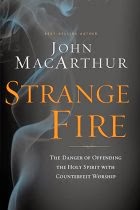
Book Review: Strange Fire, by John MacArthur

Strange Fire (release date, 12 November 2013) is an important book for Christians who long to be faithful to biblical teaching. It will be controversial as Dr. MacArthur takes a very confrontational stance on the charismatic movement. MacArthur is a strident cessationist, believing that the spiritual gifts commonly referred to as "sign gifts" (healing, miracles, prophecy, tongues, and interpretation of tongues) and the office of Apostle ceased to exist at the end of the Apostolic Age (roughly the end of the first century AD). He also issues a stern warning about the so-called "Prosperity Gospel" — the belief that those who are truly saved and who have enough faith will experience financial prosperity and physical health He calls out prominent charismatics and accuses them of fraudulent teaching about and use of these spiritual gifts and their teaching on "blessings" (the prosperity gospel), going so far as to say that they are completely unbiblical and are from Satan rather than God's Spirit. A few times, he references a Pew study that concluded that in some countries, 90% of all Pentecostals believe the same as these prominent figures.

MacArthur paints with a very broad brush, splattering paint everywhere. He challenges the teaching of several non-pentecostal evangelicals and calls them to move to a cessationist position on these spiritual gifts — John Piper, Henry Blackaby, and others.

In spite of the fact that I think MacArthur is too broad in his condemnations, this is a good book. It is written in 3 parts, each part having 4 chapters:

Part 1: Confronting a Counterfeit Revival
Ch 1 Mocking the Spirit
Ch 2 A New Work of the Spirit?
Ch 3 Testing the Spirits (Part 1)
Ch 4 Testing the Spirits (Part 2)
Part 2: Exposing the Counterfeit Gifts
Ch 5 Apostles Among Us?
Ch 6 The Folly of Fallible Prophets
Ch 7 Twisting Tongues
Ch 8 Fake Healings and False Hopes
Part 3: Rediscovering the Spirit's True Work
Ch 9 The Holy Spirit and Salvation
Ch 10 The Spirit and Sanctification
Ch 11 The Spirit and the Scriptures
Ch 12 An Open Letter to My Continuationist Friends

He concludes the book with an Appendix tracing cessationist thought from the 4th century forward.

Best Chapters: In Chapters 3 and 4, MacArthur uses 1 John 4:1-8 to give a biblical method of testing the validity of any claim to the working of God's Spirit. This is excellent exegesis which builds on an exposition of Jonathan Edwards as he evaluated the Great Awakening of the 18th century. The appropriate questions to ask are:
1. Does the work exalt the true Christ?
2. Does it oppose worldliness?
3. Does it point people to the Scriptures?
4. Does it elevate the truth?
5. Does it produce love for God and others?

Any supposed movement of the Holy Spirit that does not do all of those, is not a movement of God's Spirit and is, therefore, false.

Key Quotes:

Introduction: The “Holy Spirit” found in the vast majority of charismatic teaching and practice bears no resemblance to the true Spirit of God as revealed in Scripture. The real Holy Spirit is not an electrifying current of ecstatic energy, a mind-numbing babbler of irrational speech, or a cosmic genie who indiscriminately grants self-centered wishes for health and wealth. The true Spirit of God does not cause His people to bark like dogs or laugh like hyenas; He does not knock them backward to the ground in an unconscious stupor; He does not incite them to worship in chaotic and uncontrollable ways; and He certainly does not accomplish His kingdom work through false prophets, fake healers, and fraudulent televangelists. By inventing a Holy Spirit of idolatrous imaginations, the modern Charismatic Movement offers strange fire that has done incalculable harm to the body of Christ. Claiming to focus on the third member of the Trinity, it has in fact profaned His name and denigrated His true work.

Charismatic theology has turned the evangelical church into a cesspool of error and a breeding ground for false teachers. It has warped genuine worship through unbridled emotionalism, polluted prayer with private gibberish, contaminated true spirituality with unbiblical mysticism, and corrupted faith by turning it into a creative force for speaking worldly desires into existence. By elevating the authority of experience over the authority of Scripture, the Charismatic Movement has destroyed the church’s immune system–uncritically granting free access to every imaginable form of heretical teaching and practice.

Chapter 1: Some might argue, however, that such heretical elements represent only the lunatic fringe of an otherwise orthodox movement. More moderate charismatics like to portray the prosperity preachers, faith healers, and televangelists as safely isolated on the extreme edge of the charismatic camp. Unfortunately, that is not the case. Thanks to the global reach and incessant proselytizing of religious television and charismatic mass media, the extreme has now become mainstream. For most of the watching world, flamboyant false teachers–with heresies as ridiculous as their hairdos–constitute the public face of Christianity.

Chapter 2: Edwards argued with his usually lucid logic that intense physical phenomena such as “tears, trembling, groans, loud outcries, agonies of body or the failing of bodily strength” did not prove anything one way or the other about the legitimacy of a revival.

Chapter 4: A comparison of Ephesians 5:18 with Colossians 3:16 demonstrates that the command to “be filled with the Spirit” is parallel to the command to “let the word of Christ dwell in you richly,” since they both produce the same results (cf. Eph. 5:18–6:9; Col. 3:16–4:1)...It is not possible for God’s Word to dwell in believers unless they are filled with the Spirit; and conversely, Christians can’t be filled with the Spirit without the Word of Christ dwelling

Chapter 6: ...if someone declaring himself a prophet proclaims any supposed “revelation from God” that turns out to be inaccurate or untrue, he must be summarily rejected as a spokesman for God.

Chapter 10: being “slain in the Spirit” is a modern charismatic invention. The practice is mentioned nowhere in the Bible; it is completely without scriptural warrant. The modern phenomenon has become such a common and popular spectacle that the average charismatic today takes it for granted, assuming it must have some kind of clear biblical or historical pedigree. But not only is this phenomenon completely absent from the biblical record of the early church; it has nothing whatsoever to do with the Holy Spirit.

...for those who wonder if they are truly being filled with the Holy Spirit, the proper question is not, “Have I had an ecstatic experience?” Rather, it is, “Am I becoming more and more like Jesus?”

Chapter 11: ...the Reformation was the inevitable and explosive consequence of the Word of God crashing like a massive tidal wave against the thin barricades of man-made tradition and hypocritical religion.

Recommendation: MacArthur's defense of cessationism is compelling and has caused me to rethink my own position as a non-charismatic continuationist — though I'm probably more accurately labeled a functional cessationist.

There is much truth in this book in spite of the confrontational tone. It is worth reading by both charismatics and non-charismatics. MacArthur's exposition of Scripture should be taken seriously.

UPDATE: John Piper has responded to inquiries about MacArthur's comments related to his views as a continuationist. Frankly, I think both oversimplified the issues, particularly of prophecy, but this is a good counter to MacArthur's comments about Piper: Piper Addresses Strange Fire and Charismatic Chaos.

(DISCLAIMER: I received this book, Kindle edition, free for pre-publication review from the publisher's Booksneeze blogger's review program. I received no other compensation except for continued participation in the program and have been free to write the review that I think the book deserves.)

26 October 2013

Review: The Race Before Us

Bruce Matson is a Richmond lawyer who ran a marathon in college but is now 49, overweight, and out of shape. He's also a church regular who is questioning his faith — "Do I really believe what I recite in the Nicene and Apostles' Creeds on Sundays?" He skillfully weaves together his twin struggles to get in both physical and spiritual shape. He took the spiritual quest seriously, wrestling with major philosophical and historical approaches to Christianity and finally realizes that, ultimately, though the intellectual assent is important, the key is trust. One of the things I liked about the book is that I know the places he ran (though, even so, I thought a couple of his descriptions of runs were a bit too detailed). I have also asked myself some of the same questions about faith.

He alternates chapters devoted primarily to running with those devoted primarily to his search for meaning in his faith. Matson deals with some questions and issues of faith that require some deep thought — a lot of Christian apologetics in this book. It was challenging and an excellent refresher on some of my seminary courses from 30+ years ago.

Some good appendices:
  • Top Ten Arguments for the Existence of the God of the Bible — He touches on and explains most of these in the text of the book, but this is a good summary list. (Christian apologetics) Throughout the book, though, he emphasizes how much he was aware that Christian faith or trust was not solely dependent on the truth of these arguments.
  • Bibliography — If one wants to explore any of the topics, these are all good sources. Matson does not just include those that support his final conclusion on faith.

(Disclaimer: I received a copy of this book free from the author in exchange for a review. However, I was free to write the review I thought the book deserved. I expect no further personal gain.)

Review: A Man Called Blessed

There are credible clues about the secret location of the Ark of the Covenant — in the monastery that Caleb and parents have rebuilt in Ethiopia, the same monastery where Caleb lived until he escaped when he was ten (Blessed Child). Caleb is the key. Both Jews and Arabs are trying to get to Caleb first. If the Jews find the Ark, they will feel compelled to destroy the mosque on the Dome of the Rock and rebuild the temple. The Arabs want to prevent that. Better than Blessed Child, perhaps because Caleb is more mature. Characters were better developed and plot line flowed more smoothly. I still didn't care for the dancing but the miraculous events were a lot easier to take and were more in line with miraculous escapes in the Old Testament. Caleb struggles with his faith — not losing it, but taking it for granted. Rebecca has killed too much and wants to be loved as a "woman" and not just identified as an assassin — will she find that with Caleb, even though he is a Christian?

Though I like it better than the first book in the series, Blessed Child, this is still not a typical Dekker book. It does have the supernatural elements but it's not the somewhat bizarre psychological thriller like Thr3e or the Boneman's Daughters.

It was helpful to have read Blessed Child first. It gave me the background to follow the story better. However, it is not necessary and apart from a few references to Caleb's child-like faith 15 years earlier, I don't think you would be lost.

(Disclaimer: I received this book free from the publisher as a part of their blogger review program, BookSneeze. However, I was free to write the review I thought the book deserved. I receive no further compensation besides continued participation in the blogger review program.)

13 October 2013

Book Review: "Blessed Child", Ted Dekker and Bill Bright

This is now my least favourite of Ted Dekker's books, replacing House and the short story, The Keeper. Thr3e defined Ted Dekker for me — a psycho-thriller with lots of twists and turns, a bit eery, clean, good wins over evil. Boneman's Daughters and Shadowdown continued those elements. The Circle Trilogy were good fantasy, again with a battle between good and evil. In all of those books, I really felt like I was in the story, seeing the world through the eyes of the characters.

Blessed Child just didn't hook me into the story in the same way. I cared about Caleb and what happened to him; I wanted Jason and Leiah to quit bickering; I wanted Crandal and his henchmen to get their due; but Dekker and Bright didn't draw me into the story.

The story was clean with just enough arguing between them and just enough mutual attraction to make the relationship between Jason and Leiah to keep their interactions believable, without cluttering it up with gratuitous physical intimacy. (Slight spoiler here.) The development of their relationship was "normal" and satisfying. The problem for me was perhaps my expectations. Dekker had set me up, in others of his books that I've read, to expect characters that seemed normal but with a hint of some intangible oddness. Jason and Leiah seemed written more like super-heroes (somewhat like Clive Cussler's characters) and Dekker and Bright just didn't pull that off well.

Caleb is a young boy who Jason and Leiah rescue from an Ethiopian Orthodox monastery just as it's being attacked by a contingent of Eritrean People Liberation Front soldiers who destroy the monastery. The EPLF soldiers pursue Jason, Leiah, and Caleb into a box canyon (not sure how else to describe it) where the first of numerous odd events, somehow connected to Caleb, occurs — an EPLF soldier is supposedly killed but then stands up and flees.

As the story develops, I really liked the tensions between Jason and Leiah on the one hand and Father Nikolous on the other. Another odd bit to the story is that Father Nikolous' church is Greek Orthodox — maybe that's only odd because of my ignorance of the similarities or connections between the Greek and Ethiopian Orthodox Churches and it's really not pertinent to the story. Also, the developing tensions between Charles Crandal, Jason and Leiah, Caleb, and Father Nikolous was well done.

The two sub-plots in the books actually helped the story. I got angry at the self-promotion of Father Nikolous and the way that he used Caleb for his own benefit. Crandal's end-justifies-the-means and win-at-all-costs approach to being elected President helped bolster the story. However, I didn't think the resolution of either of these was very satisfactory.

I suspect that some of the problems I had with the book have to do with the fact that this was an early Dekker novel — his second, published in 2001 after Heaven's Wager. Blessed Child has apparently been newly released as a Kindle edition. In later books, Dekker finds his voice and his own character development. Perhaps the fact that it was co-authored — by Bill Bright, in this case — detracts from Dekker's genius. "House", I think, suffered from the same problem (co-authored by Peretti and Dekker). Nothing against either co-author, it's just that perhaps the real Dekker doesn't come through when he writes with someone else. 

Blessed Child was a good book and a decent read. It's must not great.

This doesn't affect my review, but I continue to wish that Thomas Nelson would include page numbers and Kindle's X-Ray function in their blogger review editions. "X-Ray" is one area where Kindle really shines and it's a glaring omission.

DISCLAIMER: I received a copy of "Blessed Child" free from the publisher as a part of their Booksneeze blogger review program. I have been free to write the review that I thought the book deserved. There has been no other compensation except continued participation in Booksneeze.

28 September 2013

Book Review: "Afloat"

An interesting premise — floating condominiums built over a cove. Even without reading the story, my first thought was that the safety of living there would totally depend on the integrity of the support structure. But, I also immediately thought, "How cool would that be?!"

Healy did a reasonably good job of developing her characters. I mistrusted Tony (developer) from the get-go. I liked and trusted Vance (architect) throughout the whole story - he seemed afraid to commit, though. I felt sorry for Danielle — she was so desperate for love, affirmation, and acceptance that she was willing to compromise her principles and to believe her own lies about who really cared for her.

I was intrigued from the beginning: Who was the man in the wet suit? What kind of structure was he swimming around? What were the containers for — it did sound sinister? What were the sardine-sized creatures that flashed? Add to that, the complicated relationships between Danielle, Tony, and Vance, a freak storm, the danger of not only the destruction of the floating condominiums but the danger to the lives of the group in the occupied unit, and the building awareness that there is real evil at work and this turned into a really good story.

There are some glitches: Who summons up communications on a phone? (loc. 1287) Danielle's desire for giving Tony a 2nd chance (loc. 7462) seems highly unlikely — though, her extremely low self-esteem may account for that. However, the things she knew about Tony perhaps made her legally complicit in his crimes. Personally, I thought the silver, flashing, sardine-sized creatures were an odd addition. While those things keep me from giving this 5 stars, they really didn't detract from the compelling nature of the story.

There were shortcomings in the Kindle edition — enabling the X-ray function would have been nice; including real page numbers would have been nice; calling up the menu, tapping "Go To", and selecting "Beginning" took me to location 7635 which is the "about the author" page. However, all of those may be corrected in the actual retail edition of the book — my copy is a review copy straight from the publisher.

Disclosure: I received this book free from the publisher's BookSneeze blogger review program in exchange for a review of the book. I was free to write a review that truly reflects my views of the book. There has been no other compensation.
 Review

01 July 2013

The Most Ethnically Diverse Country on the Planet

Surprising? This map shows the planet's most and least ethnically diverse nations in the world. The countries in green are the most diverse, while those in red are the least.
This morning, a couple of Facebook friends posted links to a news article about a report from Harvard University's Institute for Economic Research regarding the most and least diverse countries and continents in the world. The article in Daily Mail Online is the most comprehensive I've sound so far. The conclusion of the study was that Uganda is the most ethnically diverse country on the planet and Africa is the most ethnically diverse continent. When I first read the news reports, I immediately thought they were wrong. After all, the Democratic Republic of the Congo has more than 300 different language groups.

I've given this some more thought. While the conclusion seems counter-intuitive — i.e., there are many countries, including the US, that have more ethnic representation — I think there are at least two items in this report that give clues about the methodology that led to the outcome. First, the Daily Mail article and the Pearl Guide report mention, "Uganda is home to more than 40 different indigenous ethnic groups...." The first key may be "indigenous" — the US, for instance, has fewer "indigenous" ethnic groups. I say "may" because, not having seen the original report, I don't know if that was really a factor in the research or simply an addition by a reporter.

Second, and probably more significant, is that it appears that the conclusion is based on what might be termed 'ethnic density' (my term — I started to say, "ethnic diversity density"). Note the question that the study attempted to answer, "If you picked two people at random in any nation and asked them their ethnicity, what are the chances that they would give a different answer?" A higher number of ethnic groups combined with a lower overall population would increase the odds that two people picked at random would be of a different ethnic group. Note that one couldn't just walk up to two people in, say, Mityana and expect those probabilities to hold true — it would have to be random selection out of the population of the entire nation.

I would be very interested in reading the study. I haven't found it, yet, so if someone comes across it, please post the link.

Run well, y'all,
Bob Allen
Nairobi

13 June 2013

American "Christian" Animism

If anyone actually reads this, it may stir up some pretty strong feelings. When Americans think of animism, we generally think of African traditional religions or the voodoo of the Caribbean. We don't generally associate animism with "normal" Americans. However....

I'm always a bit uncomfortable when I hear someone say something like, "Claim God's promises for you." It's not that I don't believe God is gracious; it's not that I don't believe that God has made and will fulfill his promises. I do believe both of those, but I also believe that often promises are taken out of context and applied to situations that God never intended. A colleague expresses it well when he says, "All the Bible was not written to me but all the Bible was written for me."

Several years ago, I taught a class on discipleship to a group of Kenyan pastors. When we talked about prayer, I used this phrase over and over, "Maombi si uchawi" (Swahili: Prayer is not witchcraft), to try to communicate that prayer is not a formula or ritual that we use to manipulate God into doing what we want. So, these paragraphs caught my attention.
Animistic salvation is utilitarian, selfish, human-directed, and this-worldly. An animist is chiefly concerned with self: He seeks power to fulfill his own earthly needs. Conversely, Christian salvation is a response to grace, altruistic and self-giving, God-focused, and includes the immediate as well as the eternal. A Christian, unlike the earthly focused animist, seeks to fulfill the purposes of God.
Such utilitarianism has also invaded the church. Prayer has frequently become a magical potion to extract human wants from God. When Christians order God to fulfill his promises, as "We claim the promises which you, God, have already granted us," they superimpose their own will upon God's sovereign will. Such prayers demand that God fulfill human desires. However, prayer should give homage and praise to God and plead with him to act while acknowledging his sovereignty.
(pp. 13-14 in Conclusion of Communicating Christ in Animistic Contexts, Gailyn Van Rheenen)
Often, not always, that kind of praying takes God's promises out of context. Any time we seek to manipulate God to do what we want rather than humbly bowing before Him, waiting to obey and receive what He wants, we're practicing animism rather than faith.

Running is a metaphor for a life of faith and obedience. Right now, I hope the metaphor doesn't describe my life — I rolled my ankle on Tuesday, so, my running is on the shelf for a few days. That's the 4th time in about 16 months and it's not fun. Frustrating.

Run well, y'all,
Bob Allen
Nairobi, Kenya

06 June 2013

Book Review: "Outreach and the Artist"

God is the ultimate Artist, is the first sentence of Con Campbell's "Conclusion" of his book, Outreach and the Artist: Sharing the Gospel With the Arts. That sentence could easily be the thesis of the whole book. It summarizes well why Christian artists occupy a natural position from which to share the Gospel, why the arts should be seen as a legitimate avenue for sharing the Gospel, and why artists need the Gospel. Campbell does an excellent job as an apologist for all three positions.

The author is unapologetically Christian, so the book may not appeal to everyone. However, I come very close to saying that every pastor, every gospel strategist, and every Christian artist ought to read this book. I suspect that every church either has, among its congregation, gifted artists who sincerely desire to use their gifting in ministry or that the community around the church includes artists who need the Gospel. While Campbell doesn't give many how-tos in the book, he presents a solid understanding of why and how art can be used in ministry.

There are 4 key points that the book highlighted for me. Other readers will almost certainly find different points that speak to them:
  • The need for the church to understand, accept, nurture, and mentor artists instead of automatically writing them off because of their unique lifestyles and perspectives.
  • The difference between the message and the medium (art as an avenue for sharing the Gospel) and the medium and the message (the art contains the message). Both are valid, according to Campbell, but the latter is usually too subtle to be the only way art is used to share the Gospel.
  • The value in approaching the artistic community as an unreached people group with its own culture — common values, language, and focus. Christian artists are best placed to reach other artists because artists tend to assign influence based on "meritocracy".
  • The understanding that art becomes god for many artists. This idolatry needs to be addressed. The medium (art) is not the issue and does not need to be abandoned; one's perspective on art is the issue.
Each chapter is followed by an "Artist Profile" of a Christian artist in which Campbell asks the artist to describe his or her artistic interests, the struggles of being a Christian in the arts, the ministry the artist has through the arts, and what that artist sees as the single biggest barrier that hinders other artists from coming to Christ. He includes musicians, visual artists, thespians, and others to give a broad perspective of the arts. This personalizes the focus of the book.

There were some formatting issues in the Kindle version that I got from the publisher. There were several divided words like "ser vice" and a few odd words like "115Christian". The font size used for the "Artist Profiles" was larger than that used for the rest of the book and I found that a little distracting. I don't know if these items are just in the review copy or if these errors also exist in the commercial edition available from resellers. Those issues were minor distractions and did not take away from the messages of the book.

DISCLAIMER: I received a free copy of this book through the publisher's blogger review program in exchange for a review of the book. I was free to write the review that I thought the book deserved.

02 June 2013

Book Review — Intentional Walk: An Inside Look at the Faith That Drives the St. Louis Cardinals

I have never been a St. Louis Cardinals fan. I don't have anything against the Cards, but I'm a life-long Yankees fan and have also become a Braves fan in the past 30 years (yes, I'm old enough to have been a Yankee fan for much longer than I've been a Braves fan). Until this weekend, I probably could not have named a single Cardinals' player. So, when I saw this book, Intentional Walk: An Inside Look at the Faith That Drives the St. Louis Cardinals (Kindle edition), I didn't decide to read it because of the team. Frankly, I decided to read it because a good friend and my brother-in-law are rabid Cardinal fans and I wanted to know something about the team. Secondly, I decided to read it because I was intrigued that a baseball team would be known for its cadre of Christian players to the point that someone would write a book about that.

What I found is that this book is not really a book about baseball. You won’t find juicy tidbits of gossip about the players. There’s no recounting of deals gone sour. For the most part, there are no play-by-play retelling of games. Except for chapter 17, "The Postseason", about the Cards in the 2012 playoffs, this is really a book about baseball players and how their faith in Christ impacts their lives both on and off the field. I was disappointed at first and I really think the book would have benefited from a bit more baseball. In the end, though, I really enjoyed the book. I didn't find the book preachy but I recognize that I'm biased towards the perspective of this book.

With 2 exceptions, Rains uses a separate chapter to talk about the faith of each of 18 different members of the Cardinals' organization — almost mini-biographies. The 2 exceptions are one chapter in which he talks about 2 players and the 17th chapter in which he talks about the 2012 postseason.

There are several themes that run through the whole book, many of them in almost every chapter:
  • God has a plan that may not match our plan
  • God is not selecting the winners because he's more interested in the relationship (between Him and an individual and between individuals)
  • Baseball is a game based on errors - you fail most of the time
  • You have to understand that not every day is going to be a good day
  • A believer has to be excellent in everything he does, do his best, because he's working as unto the Lord
Manager Mike Matheny's quote near the end of the book sums it up well:
I believe in every aspect of my life that I am called to excellence. I believe, through my faith, that I am called to high expectations....
This was a good read and I recommend it. (A book has to really grab me to get a 5-star rating.)

(DISCLAIMER: I received a free copy of Intentional Walk through the publisher's blogger review program, BookSneeze, in exchange for a review. I was free to write the review that I thought the book deserved.)

Run and read well, y'all,
Bob Allen
Nairobi, Kenya